

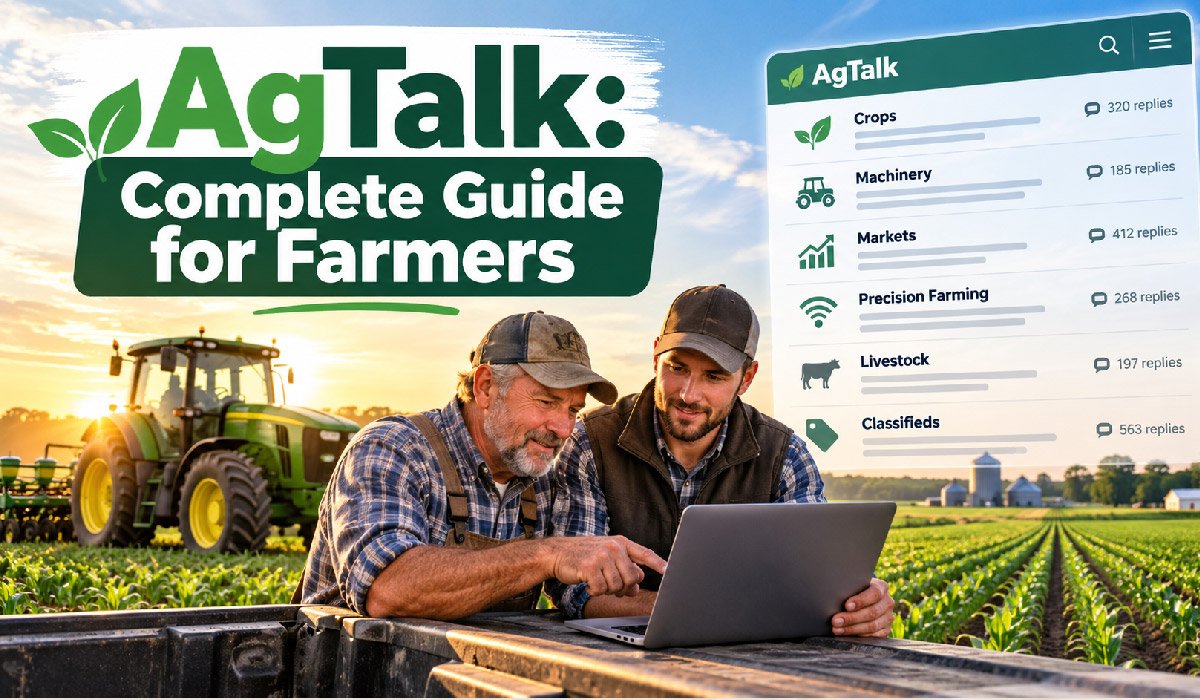
AgTalk is an online farming forum where farmers and agricultural workers share practical field experience. It is built around real questions from people who work with crops, machines, markets, livestock, and rural life every day.
Many farmers use AgTalk because farm problems often need fast and practical answers. A small mistake in seed depth, spray rate, machine setting, grain timing, or equipment repair can affect a full season.
This article explains what AgTalk is, how it works, why farmers use it, and what new users should know before trusting any advice. It also covers its main sections, benefits, limits, and best use.
What Is AgTalk?
AgTalk, also known as NewAgTalk, is a farming discussion forum made for people connected with agriculture. It allows users to ask questions, reply to topics, search old threads, and share farming knowledge.
The site uses a traditional forum style. This means topics are arranged in boards and threads instead of a fast social media feed. Users can open a topic, read replies, and follow the full discussion.
AgTalk covers many farm-related subjects, including crops, machinery, grain markets, precision technology, livestock, rural life, and classifieds. Its simple design may look old, but it helps keep technical discussions easy to follow.
Why AgTalk Is Popular Among Farmers
AgTalk is popular because it gives farmers access to real experience from other people in agriculture. Many replies come from users who have already handled the same crop issue, machine problem, or market decision.
Farming advice is often local and practical. Soil type, rainfall, crop stage, equipment model, and field history can change the right answer. AgTalk allows users from different areas to share different views.
The forum also feels direct and honest. Some replies are detailed, while others are short and blunt. This style can feel similar to a farm shop conversation, where people speak from real work instead of polished marketing.
How AgTalk Works
AgTalk works through forum boards. Each board focuses on a different subject, such as crop production, markets, machinery, technology, livestock, or general rural topics. Users choose the board that matches their question.
A user can start a thread by writing a title and message. Other users can reply with advice, questions, photos, warnings, or personal experience. Over time, the thread becomes a useful record for future readers.
The site also has search options, private messages, and classified listings. A farmer can search old discussions before posting a new question. This is useful because many common problems have already been discussed before.
Main Discussion Areas on AgTalk
AgTalk has several main discussion areas that help users find the right type of information. Crop Talk, Market Talk, Precision Talk, Machinery Talk, and Classifieds are among the most important sections.
Each area has its own purpose. Crop Talk focuses on field and crop problems. Market Talk focuses on prices and farm business choices. Precision Talk covers GPS, monitors, mapping, and farm technology.
Other boards cover machinery, livestock, trucks, shops, tools, rural life, and general conversations. This wide structure makes AgTalk more than one topic. It works like a large online meeting place for the farming community.
Crop Talk on AgTalk
Crop Talk is one of the most useful sections for field-related questions. Farmers discuss seed, fertilizer, weeds, diseases, insects, soil health, drainage, planting dates, crop damage, weather problems, and yield results.
Good Crop Talk posts usually include clear details. A farmer may explain the crop, soil type, region, planting date, chemical program, field condition, and recent weather. Photos can also help other users understand the issue.
This section is helpful for ideas, but users should still be careful. Chemical rates, crop labels, local laws, and safety rules must be checked from official sources. Forum advice should support decisions, not replace expert guidance.
Market Talk on AgTalk
Market Talk focuses on grain prices, crop sales, land values, input costs, storage choices, and farm economy topics. Many farmers use this section to understand how others are thinking about market risk.
The value of Market Talk is not only in price opinions. Users often explain why they are selling, storing, waiting, or protecting cash flow. This helps readers understand different farm situations.
Still, no market post can guarantee the future. Crop prices can change quickly because of weather, exports, interest rates, policy, and global supply. Farmers should compare forum opinions with bids, contracts, insurance, and professional advice.
Precision Talk on AgTalk
Precision Talk covers modern farm technology. Users discuss GPS systems, guidance lines, auto-steer, monitors, yield maps, data transfer, drones, displays, software updates, cables, receivers, and mixed-brand equipment setups.
This section is useful because many farms use older and newer systems together. A farmer may need help connecting a display, moving guidance lines, solving signal problems, or understanding monitor settings.
Technology advice depends heavily on model numbers and software versions. A solution that works on one display may not work on another. Users should check manuals, backups, licenses, and dealer support before changing important systems.
Machinery Talk and Equipment Advice
Machinery discussions are a major part of AgTalk. Farmers talk about tractors, combines, planters, sprayers, tillage tools, trucks, engines, hydraulics, electrical problems, parts, repairs, and machine settings.
This section can help users find common failure points. A farmer may describe a strange noise, warning light, leak, broken part, or poor field performance. Other users may share what caused the same problem on their machine.
Machinery advice can save time, but safety matters first. Heavy equipment repairs can be dangerous. Users should use service manuals, proper tools, lockout steps, and trained mechanics when the repair involves high pressure, electricity, or moving parts.
Livestock and Rural Life Discussions
AgTalk also includes discussions about livestock and rural living. Users may talk about cattle, feeding systems, fencing, barns, handling equipment, water systems, bedding, pasture management, and daily animal care.
These conversations are useful because livestock work is also practical and local. Feed prices, weather, facilities, animal health, and labor can all affect the right choice for a farm.
Rural life topics give the forum a wider community feeling. Users may discuss shops, tools, family farms, local problems, roads, construction, and off-farm life. This makes AgTalk feel connected to real farm communities.
AgTalk Classifieds Section
AgTalk has a classifieds section where users can list farm equipment, parts, trucks, tools, and other agricultural items. This area can be useful for finding used machines or hard-to-find parts.
Farmers may prefer this section because many sellers and buyers understand the equipment. A listing may include photos, price, description, location, seller name, and condition details. Older equipment may also appear there.
Buyers still need to be careful. They should confirm ownership, serial numbers, condition, payment method, pickup details, and seller identity. A classified listing is not a full inspection, especially for expensive machines or major parts.
Benefits of Using AgTalk
The biggest benefit of AgTalk is real field experience. Users can learn from people who have handled similar crop problems, repair issues, buying decisions, technology setups, and farm business choices.
Another benefit is the archive. Old threads can remain useful for years, especially when a farmer searches for a machine model, error code, chemical issue, crop symptom, or repair problem during a busy season.
AgTalk also gives multiple opinions. One user may suggest a low-cost repair, another may recommend replacement, and another may explain a warning. This helps readers compare choices before making a decision.
Limitations of AgTalk
AgTalk has limits because it is based on user replies. Some advice may be outdated, incomplete, local, or based on personal opinion. Not every user has the same level of knowledge.
A reply that works in one region may fail in another region. Soil, weather, laws, pests, machine condition, crop stage, and product labels can change the correct answer. Readers must judge the context carefully.
High-risk decisions need stronger checks. Chemical use, safety repairs, livestock health, legal issues, contracts, warranties, and large financial choices should be verified with qualified experts, official documents, or trusted local advisers.
How to Search AgTalk for Better Answers
Searching AgTalk before posting can save a lot of time. Many common questions have already been answered in older threads. A good search may show repairs, warnings, and results from past seasons.
Use specific words when searching. Add the machine model, brand, product name, error code, crop issue, part number, year, or symptom. Specific searches usually give better results than broad terms.
It also helps to check the date of each thread. Older advice can still be useful, but equipment, software, chemical labels, and market conditions may change. Readers should use old posts as clues, not final answers.
How to Ask a Good Question on AgTalk
A good AgTalk question should be clear and detailed. The title should explain the problem, such as a planter issue, combine warning, crop symptom, spray concern, or GPS problem.
The post should include important facts. For machinery, add model, year, symptoms, recent repairs, and what has already been tested. For crops, add location, crop, soil, planting date, weather, and product history.
Clear questions usually get better answers. Photos can also help. After solving the problem, users should return with an update. That makes the thread more useful for the next farmer with the same issue.
AgTalk vs Social Media Farming Groups
AgTalk is different from social media farming groups. Social platforms move fast, and posts can disappear quickly in a feed. AgTalk keeps discussions in searchable threads that are easier to revisit later.
Social media can be useful for quick replies, photos, and local groups. However, long technical discussions may become hard to follow when comments are mixed with unrelated posts and reactions.
AgTalk’s older forum style is simple, but it works well for farming problems. A user can search by topic, read past replies, compare details, and follow the full discussion without the pressure of a fast-moving feed.
Is AgTalk Reliable?
AgTalk can be reliable for practical experience, but it should not be treated as an official source for every decision. Its strength is peer-to-peer knowledge from people who work in agriculture.
A helpful thread may show what other farmers tried, what worked, what failed, and what problems appeared later. This kind of experience is often missing from product pages and short manuals.
Still, reliability depends on the topic and the reply. Readers should compare several answers, check the user’s details, look for real examples, and verify important information with labels, manuals, advisers, dealers, or professionals.
Who Should Use AgTalk?
AgTalk can be useful for farmers, farm managers, equipment operators, crop advisers, livestock owners, mechanics, rural landowners, and people learning about agriculture. Each group can use the forum in a different way.
Farmers may use it for planting, spraying, harvest, machinery, and market questions. Equipment owners may use it for repairs, parts, and settings. Advisers may use it to understand field problems being discussed by growers.
New learners can also benefit, but they should read carefully. AgTalk uses real farm language, and some replies may assume background knowledge. Beginners should use the forum to learn terms, patterns, and practical questions.
Tips for New AgTalk Users
New users should start by reading old threads and learning how the forum is organized. This helps them understand the tone, common topics, and type of details that make a post useful.
Before posting, use search with specific words. When asking a question, write a clear title and include important details. Avoid vague posts because users cannot give strong answers without enough information.
It is also important to stay respectful and open-minded. Farming methods can vary by region and operation size. Read several replies, compare the reasoning, check facts, and come back with the final result when possible.
Final Thoughts
AgTalk remains useful because farming is full of real problems that do not always fit simple manuals. Weather changes, machines break, markets move, and technology must work in difficult field conditions.
The forum gives farmers a place to share experience about crops, machinery, markets, precision tools, livestock, classifieds, and rural life. Its plain design is not the main value. The value comes from the users.
For the best results, readers should use AgTalk as a practical research tool. Ask clear questions, search old threads, compare several replies, and verify high-risk advice before making important farm decisions.
(FAQs) About AgTalk
What is AgTalk?
AgTalk is an online farming forum where farmers, equipment owners, crop advisers, and rural users discuss real farm problems. It covers crops, machinery, markets, precision farming, livestock, classifieds, and daily agricultural topics.
Is AgTalk useful for farmers?
Yes, AgTalk is useful for farmers because it shares real field experience from other growers. Farmers can ask questions, compare ideas, read old discussions, and learn practical solutions for crops, machines, and farm decisions.
What topics are discussed on AgTalk?
AgTalk discusses many farming topics, including Crop Talk, Market Talk, Precision Talk, machinery repairs, livestock, rural life, farm tools, trucks, land values, grain prices, and used equipment listings.
Can I trust advice from AgTalk?
AgTalk can be helpful, but users should not trust every reply without checking. Forum advice may be based on personal experience, so important decisions about chemicals, safety, repairs, markets, and money should be verified.
Does AgTalk have classifieds?
Yes, AgTalk has a classifieds section where users can list farm equipment, parts, trucks, tools, and related agricultural items. Buyers should still check condition, seller details, serial numbers, payment terms, and pickup information carefully.
You may also read: Nahttypen in Sewing: Easy Types and Tips
