

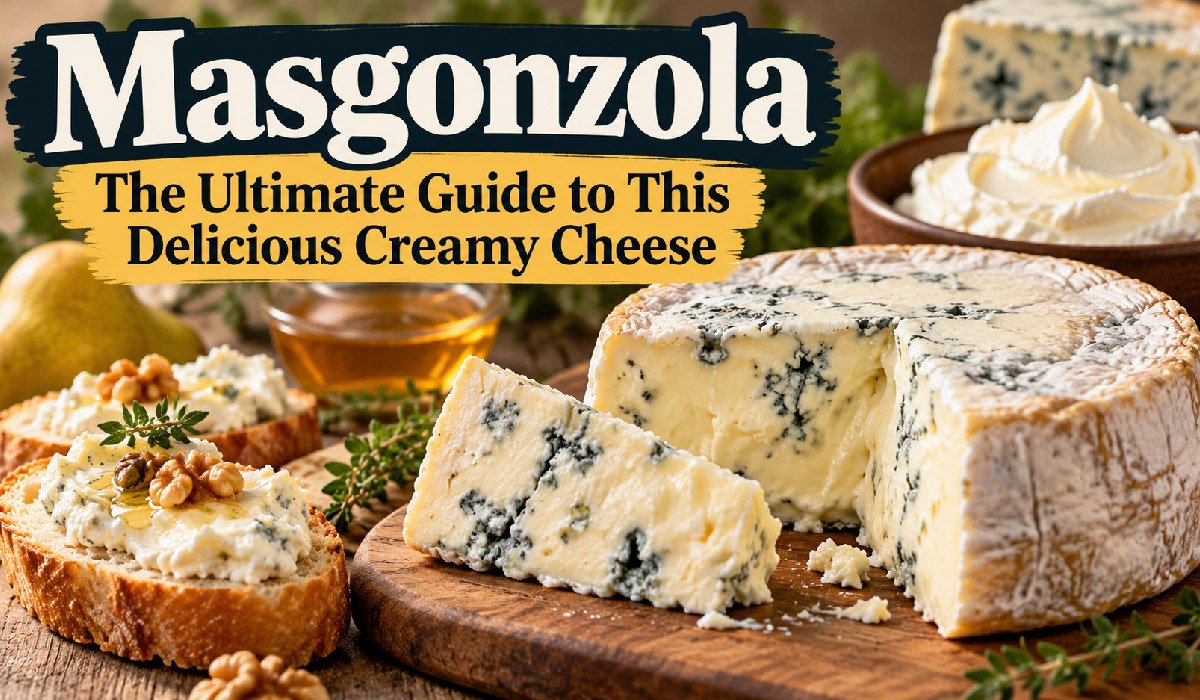
Masgonzola is an unusual food name that sounds like a traditional Italian cheese. The word is close enough to Gorgonzola that many people assume it belongs to the same family of officially recognized cheeses. However, Masgonzola is better understood as a creamy combination of Gorgonzola and mascarpone rather than a completely separate protected cheese.
The growing interest in Masgonzola also comes from confusion surrounding its name. Different food pages, recipes, and product descriptions may use slightly different terms for a similar combination. Some products blend the two cheeses completely, while others place mascarpone and Gorgonzola in separate layers. This means there is no single appearance or recipe that defines every Masgonzola-style product.
Understanding Masgonzola becomes easier when its two main components are considered separately. Gorgonzola supplies the distinctive blue-cheese character, while mascarpone adds softness and richness. Together, they create a creamy food that can work in pasta, risotto, sauces, appetizers, pizza, and cheese boards. This guide explains its meaning, ingredients, flavor, nutrition, uses, and common misconceptions.
What Is Masgonzola?
Masgonzola generally refers to a cheese specialty that combines Gorgonzola with mascarpone. Gorgonzola is a well-known Italian blue cheese, while mascarpone is a rich and mild dairy product with a smooth texture. Combining them creates a softer cheese preparation that keeps recognizable blue-cheese flavors without always having the full intensity of Gorgonzola on its own.
There is no single universal recipe for Masgonzola. One producer may use similar amounts of Gorgonzola and mascarpone, while another may use more of one ingredient. The cheeses may also be blended into a uniform mixture or arranged in layers. These differences affect the flavor, appearance, richness, and consistency of the finished product.
The exact word Masgonzola may not appear on every package containing this combination. Consumers can encounter similar products under names such as Gorgonzola with mascarpone, Gorgonzola e mascarpone, or Gorgonzola-mascarpone. Therefore, Masgonzola is most useful as a descriptive culinary term rather than a guarantee of one standardized recipe, production process, or legally defined cheese variety.
Is Masgonzola a Real Italian Cheese?
The ingredients and cheese combination associated with Masgonzola are real, but an important distinction is necessary. Masgonzola should not automatically be described as a separate traditional Italian cheese with its own protected geographical identity. Products combining Gorgonzola and mascarpone exist, but that does not give Masgonzola the same official classification as Gorgonzola itself.
Gorgonzola has Protected Designation of Origin status and is produced according to established requirements. Its protected identity connects the cheese with specific production areas and standards. Masgonzola does not have a separately established PDO identity based on the information available. Claims describing it as an ancient protected variety should therefore be treated carefully unless reliable evidence supports them.
Calling Masgonzola completely fake would also be misleading. The culinary concept behind the word is genuine because Gorgonzola and mascarpone are used together in real cheese preparations and recipes. The safer explanation is that Masgonzola describes a Gorgonzola-mascarpone specialty rather than a separate protected cheese. This distinction explains why people can find the food even when the exact name is less standardized.
Masgonzola Meaning and Origin of the Name
The meaning of Masgonzola becomes clearer when the word is examined alongside mascarpone and Gorgonzola. Its name appears to combine recognizable elements of these two Italian dairy products. This gives people an immediate clue about what the food may contain, even when they have never encountered the term before.
Its exact naming history is less clear. There is no reliably established single inventor, historic town, or creation date for Masgonzola in the available information. For this reason, it would be inaccurate to create a detailed traditional origin story around the word. Its Italian sound alone is not proof that Masgonzola has existed for centuries as an independent regional cheese.
The name is nevertheless effective because it is short and memorable. Someone familiar with Gorgonzola may immediately associate Masgonzola with blue cheese, while the mascarpone connection explains its creamier character. This combination of familiar sounds can also create confusion. People may mistake a descriptive or commercial food name for an official cheese category, making clear explanations particularly important when discussing Masgonzola.
Gorgonzola and Mascarpone: The Main Ingredients
Gorgonzola provides most of Masgonzola’s distinctive savory personality. It is an Italian blue cheese made from cow’s milk and recognized for its characteristic blue-green veining. Depending on the type and maturation, its flavor can range from relatively creamy and gentle to sharper and more pronounced, with salty, tangy, earthy, and savory qualities.
Mascarpone plays a very different role. It is smooth, rich, mild, and creamy, without the strong blue-cheese character associated with Gorgonzola. When combined with a stronger cheese, its richness can soften sharp flavors and create a rounder mouthfeel. This is why it works particularly well when paired with Gorgonzola.
The balance between these ingredients determines much of Masgonzola’s final character. A preparation containing more mascarpone will generally feel milder, richer, and creamier. Increasing the Gorgonzola can produce a saltier and more noticeable blue-cheese taste. Since no universal ratio defines Masgonzola, consumers should check individual product labels when they want to know exactly what they are buying.
How Is Masgonzola Made?
Masgonzola does not have one official production method. Generally, Gorgonzola and mascarpone are produced separately before being brought together. Gorgonzola undergoes its own cheesemaking and maturation process, during which its characteristic blue veins and flavor develop. Mascarpone provides the fresh, creamy component that is later combined with the finished blue cheese.
One approach is to blend or gently fold the cheeses together. This distributes the Gorgonzola throughout the mascarpone and can create a relatively consistent flavor in each bite. The amount of mixing also affects appearance. Light mixing can leave visible streaks or marbling, while more complete mixing produces a more uniform creamy preparation.
Another approach uses alternating layers of Gorgonzola and mascarpone. This creates clear visual differences between the pale mascarpone and blue-veined cheese. Each bite may contain a slightly different balance depending on the layers. Neither method should be treated as the only authentic Masgonzola technique because the term does not represent one standardized recipe with mandatory production requirements.
What Does Masgonzola Taste Like?
Masgonzola generally combines creaminess with recognizable blue-cheese flavor. The mascarpone can provide buttery richness and a mild dairy taste, while Gorgonzola introduces saltiness, tang, earthiness, and savory depth. The result can feel considerably softer on the palate than eating a strongly flavored piece of blue cheese by itself.
Flavor intensity depends heavily on the ingredients and proportions. A Masgonzola-style product made with plenty of mascarpone can have a gentle blue-cheese character surrounded by creaminess. A preparation containing a higher proportion of Gorgonzola may be noticeably stronger, saltier, and more pungent. The particular type of Gorgonzola used can also influence the experience.
This balance may make Masgonzola appealing to people who are curious about blue cheese but find stronger varieties overwhelming. It does not completely hide Gorgonzola’s distinctive character. Instead, mascarpone changes how that character is experienced. The result is a combination that can provide blue-cheese complexity while remaining smooth enough for spreads, sauces, and creamy dishes.
Masgonzola Texture and Appearance
The texture of Masgonzola is generally soft, rich, and creamy because mascarpone contributes considerable smoothness to the combination. It can be easy to spread on bread or crackers and can also melt effectively into warm dishes. However, its exact consistency varies according to the proportions of the two cheeses and the way they are combined.
Its appearance is equally variable. A blended preparation may have a pale creamy base with small blue or green traces from the Gorgonzola. A lightly mixed version can appear marbled, with stronger visual differences between the ingredients. Layered products may show clear sections of white mascarpone separated by blue-veined Gorgonzola.
Because there is no universal Masgonzola specification, appearance alone cannot determine whether a product fits the term. Two products can contain the same basic cheeses yet look noticeably different. Consumers should therefore focus on the ingredient list and product description rather than expecting every version to have an identical shape, color, texture, or distribution of blue veining.
Masgonzola vs Gorgonzola
Masgonzola and Gorgonzola are closely connected, but they should not be treated as the same thing. Gorgonzola is a recognized Italian blue cheese with an established identity and protected designation. Masgonzola generally describes a preparation in which Gorgonzola is combined with mascarpone, creating differences in composition, flavor, texture, and culinary use.
Straight Gorgonzola usually provides a clearer blue-cheese experience. Its taste can range in intensity depending on the variety and maturation, but the blue-cheese character remains central. Adding mascarpone changes that balance. Masgonzola is normally softer, creamier, easier to spread, and potentially milder because the mascarpone reduces the concentration of Gorgonzola in each bite.
Their official status is another major difference. Gorgonzola has protected geographical recognition, whereas Masgonzola should not be presented as possessing an equivalent independent protected designation. For cooking, the choice depends on the desired result. Gorgonzola suits dishes requiring a more direct blue-cheese flavor, while Masgonzola can work better when additional creaminess and gentler intensity are preferred.
Masgonzola Nutrition and Lactose Content
There is no single nutritional profile for Masgonzola because its recipe is not standardized. Calories, protein, fat, saturated fat, carbohydrates, sodium, and other values depend on the cheeses used and their proportions. Mascarpone is particularly rich, so adding a substantial amount can make the final preparation high in fat and energy.
Masgonzola can also provide nutrients associated with dairy foods, including protein and calcium. However, its richness means portion size is worth considering. A small serving may provide enough flavor for pasta, bread, vegetables, or an appetizer without requiring a large quantity. People monitoring saturated fat, sodium, or calories should rely on the nutrition panel of the particular product.
Masgonzola should also not automatically be described as lactose-free. Information about Gorgonzola alone cannot necessarily be applied to a preparation containing mascarpone. The final lactose content depends on the ingredients used. Anyone with lactose intolerance should check the individual label or manufacturer information. Masgonzola contains dairy proteins and is not appropriate for someone with a milk allergy.
How to Use Masgonzola in Cooking
Masgonzola is particularly useful in cooking because its creamy consistency allows it to melt into warm foods. Pasta is one of the easiest applications. A small amount can be stirred into hot pasta, sometimes with a little cooking water, to create a smooth sauce. Mushrooms, spinach, walnuts, onions, or pears can provide complementary flavors.
Risotto is another suitable dish because its naturally creamy texture works well with soft cheese. Masgonzola can be incorporated near the end of cooking to add richness and savory blue-cheese depth. Small portions can also be placed on pizza or flatbread, where the cheese melts and pairs effectively with mushrooms, onions, vegetables, pears, or nuts.
Cold uses are equally simple. Masgonzola can be spread on crostini, crackers, or fresh bread and served as an appetizer. It may also work in stuffed vegetables, savory fillings, or creamy sauces. Since both mascarpone and Gorgonzola are rich ingredients, beginning with a modest amount allows the cook to build flavor without making the dish excessively heavy.
Best Foods to Pair With Masgonzola
Sweet ingredients are among the most useful partners for Masgonzola because they contrast with Gorgonzola’s salty and tangy character. Pears, figs, apples, grapes, and dates can work particularly well. Honey can also provide sweetness without hiding the cheese. These combinations are suitable for crostini, appetizers, cheese boards, and simple desserts with savory elements.
Nuts add another useful contrast. Walnuts are especially compatible with blue-cheese flavors because their earthy character complements Gorgonzola while their crunch contrasts with mascarpone’s softness. Hazelnuts or almonds can serve a similar purpose. Bread, baguette slices, and plain crackers provide a neutral base that allows the cheese to remain the main flavor.
For savory dishes, Masgonzola can pair with mushrooms, caramelized onions, pumpkin, potatoes, leafy greens, and roasted vegetables. The goal is balance rather than adding as many strong ingredients as possible. Since the cheese already contains richness, saltiness, creaminess, and blue-cheese complexity, simple supporting ingredients often produce a more enjoyable result than heavily seasoned combinations.
How to Buy and Store Masgonzola
Finding Masgonzola can be difficult if shoppers search only for that exact name. Retailers and producers may describe similar preparations as Gorgonzola and mascarpone, Gorgonzola e mascarpone, Gorgonzola with mascarpone, or a Gorgonzola-mascarpone specialty. Searching for the two underlying cheeses can therefore produce better results than relying on “Masgonzola” alone.
When choosing a product, read the ingredient list and description carefully. A higher proportion of mascarpone generally suggests a milder and creamier result, while more Gorgonzola usually means stronger blue-cheese flavor. Buyers can also check whether the product is blended or layered and whether the Gorgonzola component carries the relevant protected designation.
Storage instructions on the package should take priority because formulations and packaging differ. As a soft dairy product, Masgonzola should normally remain refrigerated and properly covered after opening. Clean utensils help reduce contamination. Consumers should follow use-by information rather than assuming every product has the same shelf life, and cheese showing unusual signs of spoilage should not be eaten.
Common Myths and Confusion About Masgonzola
One common misconception is that Masgonzola is simply another name for Gorgonzola. This overlooks the mascarpone component that gives the preparation much of its creaminess. Another misconception is that Masgonzola represents an ancient, independently protected Italian cheese. The available information does not establish such a separate protected identity or a single traditional origin story.
It is also incorrect to assume that every Masgonzola product follows an equal Gorgonzola-to-mascarpone ratio. Recipes and commercial products can differ significantly. Some preparations are blended, while others are layered. These variations affect flavor, texture, appearance, nutrition, and intensity, which is why one example should never be presented as the universal Masgonzola formula.
At the opposite extreme, calling Masgonzola entirely fictional is also too simplistic. Gorgonzola and mascarpone combinations are genuine culinary preparations. Much of the confusion comes from the unusual name and inconsistent online usage. The most accurate approach is to examine the context, ingredients, and producer rather than assuming that a convincing Italian-sounding name automatically represents a separate historical cheese category.
Final Thoughts
Masgonzola is best understood as a creamy combination of Gorgonzola and mascarpone rather than a completely separate protected Italian cheese. Its appeal comes from the contrast between the two components. Gorgonzola contributes salty, tangy, earthy blue-cheese character, while mascarpone supplies softness, richness, and a milder creamy foundation.
The lack of one standardized recipe also explains why Masgonzola can vary considerably. One version may be mild and highly creamy, while another may have a much stronger blue-cheese taste. Products can be mixed, marbled, or layered, and they may be sold under several different names. Nutrition and lactose content can vary for the same reason.
For consumers, the simplest approach is to look beyond the name. Check the ingredients, proportions, labeling, storage instructions, and product description. Masgonzola can be useful in pasta, risotto, pizza, sauces, bread, appetizers, and cheese boards. Understanding what is actually inside the product makes its unusual name much less mysterious.
(FAQs)
What is Masgonzola?
Masgonzola is generally a creamy combination of Gorgonzola and mascarpone. Gorgonzola provides the tangy blue-cheese flavor, while mascarpone adds a mild, buttery texture that makes the combination softer and creamier.
Is Masgonzola a real Italian cheese?
The Gorgonzola and mascarpone combination is real, but Masgonzola is not established as a separately protected Italian cheese like Gorgonzola PDO. It is better understood as a name for this creamy cheese combination.
What does Masgonzola taste like?
Masgonzola usually tastes creamy, buttery, tangy, salty, and slightly earthy. Its exact strength depends on the ratio of Gorgonzola to mascarpone. More mascarpone generally creates a milder flavor.
How can you use Masgonzola in cooking?
Masgonzola can be used in pasta, risotto, pizza, creamy sauces, crostini, and appetizers. It can also be spread on bread or crackers and served with fruit and nuts on a cheese board.
Is Masgonzola the same as Gorgonzola?
No. Gorgonzola is a recognized Italian blue cheese with protected status. Masgonzola generally combines Gorgonzola with mascarpone, giving it a softer texture and usually a milder, creamier blue-cheese flavor.
You may also read: Coyyn: Powerful Guide to Digital Finance and Its Key Benefits
