

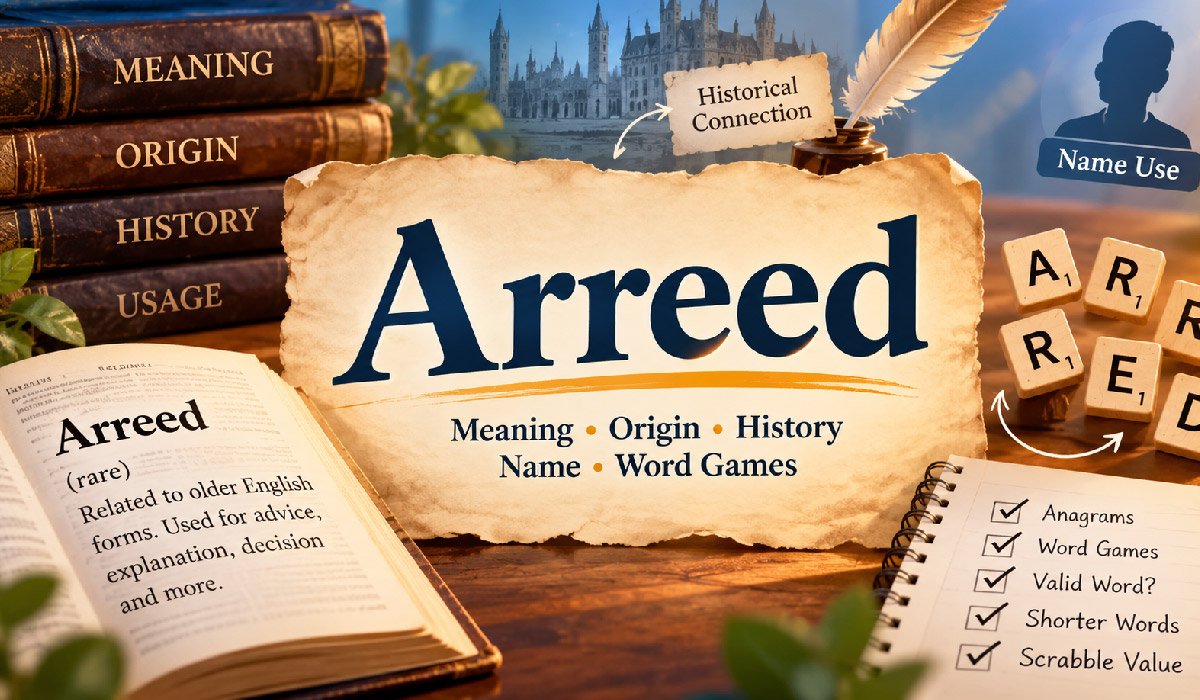
Arreed is an unusual term that can be confusing when it appears in search results. It does not have one simple modern definition. Depending on the context, Arreed may relate to historical English vocabulary, a personal name, or letters entered into a word puzzle.
The strongest language connection comes from older words such as aread, arede, and arreede. These historical forms were used for ideas such as explaining, interpreting, advising, declaring, guessing, or reaching a decision. Most of these uses are now archaic or obsolete.
Arreed can also appear in completely different situations. It is used as a personal name, while word-game websites recognize ARREED as six letters that can create words such as reader and reread. Understanding the context is therefore essential before assigning it a meaning.
What Is Arreed?
Arreed is best described as a rare spelling or search term with several possible interpretations. It should not automatically be treated as an ordinary modern English word. The meaning depends heavily on whether the surrounding material concerns language, names, or puzzles.
From a linguistic perspective, the closest documented forms include aread, arede, and arreede. Collins identifies “arreede” as a variant of “aread.” The dictionary records meanings involving declaring, guessing, interpreting, advising, and making a decision.
However, those dictionary records do not prove that every modern appearance of “Arreed” has the same historical meaning. The spelling can function as someone’s first name or simply as letters entered into an anagram tool. Context remains the safest guide.
Where Does the Meaning of Arreed Come From?
The historical explanation becomes clearer when Arreed is compared with aread. Older dictionaries record aread, and the spelling also appears as arede, areed, and arreede in historical references. Such variation was more common before English spelling became strongly standardized.
The older verb covered several related ideas. A person could use it when declaring or explaining something, interpreting difficult information, giving advice, guessing, or reaching a judgment. Collins now labels several of these meanings archaic or obsolete rather than normal contemporary English.
These meanings have a shared theme: understanding something and communicating or acting upon that understanding. Still, modern readers should avoid forcing a historical definition onto every occurrence of Arreed. A modern name or puzzle entry may have no linguistic connection whatsoever.
Arreed, Aread, Arede, and Arreede
Several similar spellings appear when researching Arreed, and separating them helps prevent confusion. Aread is the main historical dictionary form, while arede and arreede are recorded alternatives. Arreed itself is much less clearly established as the standard form in modern dictionaries.
Collins defines arreede specifically as a variant spelling of aread, while its entry for arede directs readers to the same word. This provides reliable evidence that several visually similar historical spellings belonged to the same vocabulary family.
A historical dictionary also records aread and areed, showing that spelling variation existed around this vocabulary. Therefore, when Arreed appears in discussions of old English, checking the original spelling and source is more accurate than assuming all similar-looking forms are identical.
What Did the Historical Word Mean?
One historical meaning connected with aread was to declare or tell. Another involved explaining or interpreting something. These senses make the word relevant to older writing where a speaker might reveal information, explain a difficult matter, or interpret something uncertain.
The word could also refer to advising or counseling. Collins preserves “to advise” as a literary sense, while older dictionary material records related ideas such as counseling, warning, and directing. These meanings show the unusually broad range once associated with the verb.
Other senses included guessing, divining, or deciding. Most people would use completely different vocabulary for these actions today. That is an important reason Arreed-related searches require historical context: an old definition can be technically documented while remaining unfamiliar to modern English speakers.
Is Arreed Still Used in Modern English?
Arreed is not an everyday word that readers are likely to encounter in ordinary modern conversation. The related dictionary forms themselves are marked with labels such as archaic, obsolete, or literary, indicating that their historical senses are no longer standard everyday usage.
This does not make the historical vocabulary meaningless. Old words remain valuable when studying literature, dictionaries, manuscripts, and the development of English. They can explain passages that seem unclear when interpreted only through the vocabulary and spelling conventions used by modern speakers.
For ordinary writing today, clearer modern verbs such as advise, interpret, explain, declare, guess, or decide will usually communicate the intended meaning better. Arreed and its historical relatives are mainly useful when the original spelling, historical setting, or linguistic discussion matters.
Why Does Arreed Have Different Meanings Online?
Search engines organize pages by relevance rather than guaranteeing that every result discusses the same meaning. Because Arreed is uncommon, results can mix dictionaries, word-unscrambling tools, academic references, and modern articles. Those pages may be answering entirely different questions about the same spelling.
For example, a dictionary result may lead to the historical word arreede, while a puzzle site may accept ARREED merely as six letters to rearrange. Academic search results can instead lead to publications by a person whose given name is Arreed.
This distinction matters when researching rare terms. A search result alone is not evidence that every interpretation shares one origin. Readers should identify the type of source first, then decide whether they are researching vocabulary, a person, a name, or an anagram.
Arreed as a Personal Name
Arreed can function as a personal name, and this use should be separated from historical vocabulary. A clear documented example is Arreed F. Barabasz, whose name appears in scholarly publications dealing with psychology and hypnosis. This establishes Arreed as a real given name.
Oxford Academic identifies Arreed F. Barabasz, PhD, with Washington State University. He and Marianne Barabasz are credited with the chapter “Hypnosis and the Brain” in The Oxford Handbook of Hypnosis: Theory, Research, and Practice.
That example does not establish a universal meaning, nationality, or origin for everyone named Arreed. Personal names and historical words can share spellings without necessarily sharing etymology. Claims about the name’s cultural origin or popularity therefore require separate evidence from reliable naming records.
Arreed in Anagrams and Word Games
ARREED is also useful as a six-letter combination for anagram puzzles. Its letters are A, D, E, E, R, and R. Because E and R each occur twice, players must pay attention to repeated letters when creating valid combinations.
Several familiar six-letter words can be made by rearranging all six letters. Common examples include dearer, reader, reared, and reread. Some databases additionally accept redear, while broader word finders may display rarer entries depending on their underlying dictionary.
The important distinction is that an anagram tool can accept ARREED as input without declaring “arreed” itself a playable word. Word finders are designed to rearrange supplied letters, so the input does not automatically have to be a dictionary-approved game word.
How Many Words Can Be Made From Arreed?
There is no universal total because different word tools use different dictionaries. Unscramble.org reports 37 words from the letters in ARREED. Its results include five six-letter combinations: dearer, reader, reared, redear, and reread.
WordUnscrambler.net produces a broader result, reporting 53 words. Its six-letter list adds the uncommon “dreare” to dearer, reader, reared, redear, and reread. This difference demonstrates why two apparently similar word-solving websites can return different totals.
Neither total should automatically be treated as universal for every word game. Dictionaries can differ in their treatment of archaic, regional, specialized, or uncommon vocabulary. Players should therefore check the specific dictionary or rules used by their game before making a competitive play.
Shorter Words You Can Make From Arreed
The letters in Arreed can produce useful shorter combinations as well. Five-letter results reported by several word tools include darer, drear, eared, erred, and rared. Familiar choices such as “eared” and “erred” can be easier to recognize quickly.
Four-letter possibilities include dare, dear, deer, rare, read, rear, and reed. Three-letter combinations include familiar choices such as are, ear, era, err, and red. Exact lists can expand when a tool includes uncommon dictionary entries.
Short words can be more useful than long ones in board games. They may fit restricted spaces, connect with existing tiles, or reach valuable bonus squares. Therefore, solving ARREED effectively is not always about finding the longest possible combination from the available letters.
Is Arreed a Valid Scrabble Word?
Seeing ARREED on an unscrambling website does not establish that Arreed itself is a legal Scrabble word. A word finder accepts a collection of letters and searches its database for possible combinations. The original sequence can simply function as puzzle input.
For example, UnscrambleX returns dearer, reader, reared, redear, and reread as six-letter results from ARREED. It lists those results at seven Scrabble points each, but that information concerns the generated words rather than proving ARREED itself is accepted.
Scrabble legality also depends on the official lexicon or version being used. A general-purpose word website can contain vocabulary outside a particular game dictionary. When points or competitive play matter, verify an unfamiliar word against the accepted dictionary for that specific game.
How to Understand Arreed in the Right Context
Start by examining where you found Arreed. If it appears in an old text, dictionary discussion, or article about historical vocabulary, investigate aread, arede, arreede, and related forms. Historical dictionaries are more useful here than modern puzzle websites.
If ARREED appears beside terms such as unscramble, letters, anagram, tiles, points, or word finder, it is probably being treated as a letter combination. In that situation, the goal is usually to create accepted words rather than define ARREED itself.
If Arreed appears before a surname or alongside a university, research paper, author credit, or professional title, treat it as a person’s name first. Checking the full name and original academic or institutional source will normally provide a more accurate interpretation.
How to Research Rare Terms Like Arreed
Rare terms require more careful research than familiar words because search results can combine unrelated material. Begin with an established dictionary when investigating language. Look for usage labels such as archaic, obsolete, literary, dialectal, or historical, because these labels change how definitions should be understood.
For people and academic names, prioritize universities, publishers, scholarly databases, and original publications. Oxford Academic, for example, directly verifies Arreed F. Barabasz’s authorship and institutional affiliation, making it stronger evidence for that specific claim than an unsourced biography page.
For word games, determine which dictionary the tool uses. A broad unscrambler may deliberately include vocabulary that another platform excludes. Keeping linguistic evidence, biographical evidence, and game dictionaries separate prevents three different uses of Arreed from being incorrectly combined into one definition.
Final Thoughts
Arreed is unusual because its meaning cannot be explained accurately with a single modern definition. Its strongest linguistic connection is with historical forms including aread, arede, and arreede, associated with ideas such as declaring, interpreting, guessing, advising, and deciding.
The spelling also has uses outside historical language. Arreed appears as a personal name, including that of psychologist Arreed F. Barabasz, while ARREED works as a six-letter input for anagram tools that generate words such as reader, reread, reared, and dearer.
The key is context. A dictionary, academic publication, and word-game website may all contain Arreed while discussing entirely different subjects. Checking the spelling, source type, surrounding words, and relevant dictionary provides a much more reliable answer than assuming every search result describes one meaning.
(FAQs)
What Does Arreed Mean?
Arreed does not have one clear modern meaning. It is commonly connected in searches with historical forms such as aread and arreede, whose recorded meanings include declaring, guessing, interpreting, advising, and deciding. Arreed may also appear as a name or puzzle input.
Is Arreed a Real English Word?
The exact spelling Arreed is uncommon in contemporary English. Reliable dictionaries clearly document closely related forms including aread, arede, and arreede. Because the modern spelling may have other uses, readers should check its context rather than automatically applying an archaic definition.
What Is the Origin of Arreed?
Its linguistic connection points toward older forms of aread. Historical sources record alternative spellings, while Wiktionary traces aread to Old English forms arēdan and arǣdan. The origin of a modern personal name spelled Arreed should not be assumed from that connection alone.
What Words Can Be Made From Arreed?
Using the letters A, R, R, E, E, and D, players can create six-letter words including dearer, reader, reared, redear, and reread according to multiple word-finding databases. Shorter combinations include words such as erred, dare, dear, read, rear, and red.
How Many Words Can Be Made From Arreed?
The number depends on the dictionary behind the word finder. One database reports 37 results, while a broader tool reports 53. The difference occurs because word databases can apply different rules and include different uncommon, historical, or specialized vocabulary.
Is Arreed a Person’s Name?
Yes. Arreed is documented as a personal name. One clear example is Arreed F. Barabasz, PhD, identified by Oxford Academic as a contributor to The Oxford Handbook of Hypnosis and affiliated with Washington State University.
You may also read: Duaction: Meaning, Benefits, Examples and How It Works
