

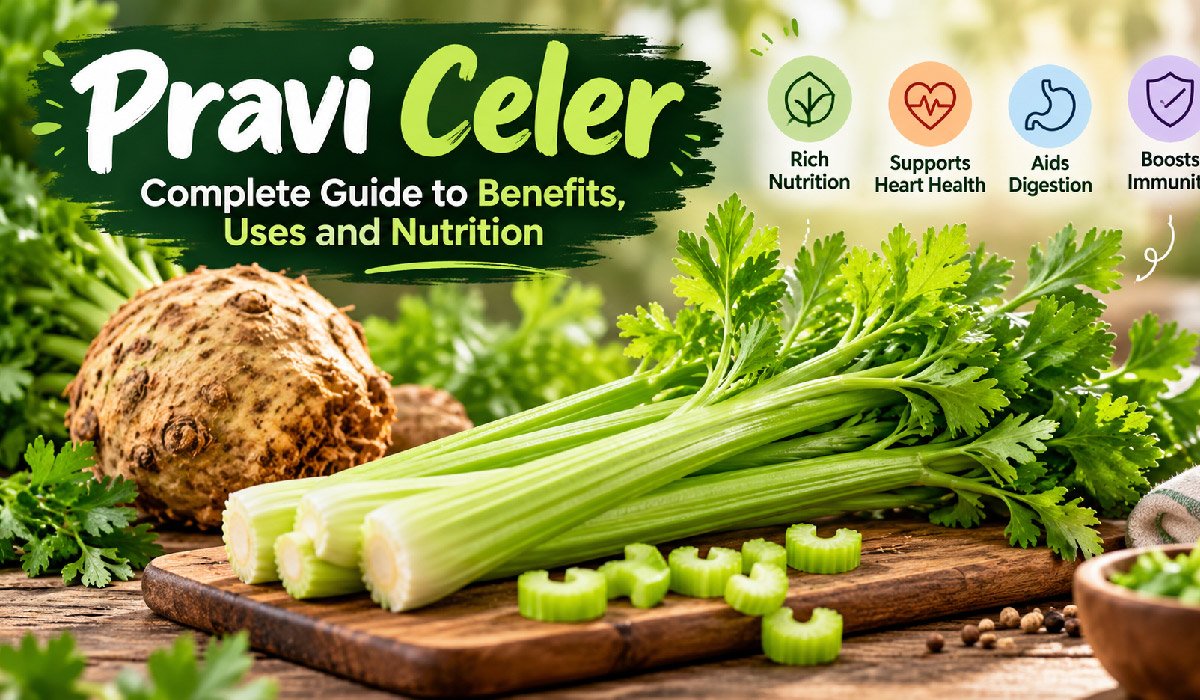
Pravi celer is a term that may look unfamiliar to English-speaking readers, but the plant behind it is surprisingly familiar. It is connected with celery, the aromatic green vegetable widely used in soups, salads, stocks, sauces, and traditional home cooking.
Interest in pravi celer has increased because online information gives several different explanations. Some sources describe it as celery root, while others present it as a special superfood. Botanical evidence provides a much simpler and more reliable explanation.
This guide explains what pravi celer means, its botanical identity, major celery types, nutrition, kitchen uses, storage, growing requirements, and safety considerations. It also clears up common claims so readers can separate useful information from online confusion.
What Is Pravi Celer?
Pravi celer is a common-name expression associated with the celery species Apium graveolens. The words can broadly be understood as “true celery” or “real celery.” It does not represent a scientifically established new vegetable species or recently developed superfood.
The important point is that celery appears in different cultivated forms. Some plants are selected for thick, crisp stalks, others for aromatic leaves, while celeriac develops a large edible lower portion. This variety can make pravi celer look different between recipes.
Therefore, the exact meaning may depend on context. A Balkan recipe could be referring to strongly aromatic celery leaves or celeriac, while another reference may simply mean ordinary cultivated celery. Identifying the plant part required is more useful than relying on the name alone.
Botanical Identity of Pravi Celer
The botanical species connected with pravi celer is Apium graveolens, which belongs to the Apiaceae family. This family also contains familiar food plants such as carrots and parsley. Kew Science currently recognizes Apium graveolens as an accepted plant species.
Celery is naturally aromatic and is primarily associated with temperate growing conditions. Kew records its native range broadly from Macaronesia and North Africa through Europe toward western parts of Asia and the Himalayas, showing its considerable geographical history.
The species is generally biennial, although vegetable growers normally harvest cultivated celery before it completes its full natural life cycle. Centuries of selection have produced forms emphasizing different edible characteristics, explaining the major differences between stalk celery, leaf celery, and celeriac.
Is Pravi Celer Different From Regular Celery?
There is no good botanical evidence that pravi celer represents a mysterious celery variety with automatically higher nutrients, better taste, or longer storage life. Those qualities depend on cultivar, growing conditions, freshness, harvest timing, handling, and the particular celery form being compared.
Regular supermarket celery is usually selected for long, fleshy, crunchy leaf stalks. Traditional European cooking may place greater importance on celery leaves or celeriac. As a result, two ingredients belonging to the same species can look and behave quite differently.
This distinction matters when following recipes. Crisp stalk celery works well raw and provides texture, while celeriac offers a denser texture and more concentrated earthy celery character. Strongly aromatic leaves, meanwhile, can season soups and broths without providing the bulk of stalks or celeriac.
Main Types of Celery
Stalk celery is probably the form most familiar to shoppers in the United States and many other countries. It produces thick, crisp petioles that can be eaten raw, sliced into salads, added to soups, or cooked with other aromatic vegetables.
Leaf celery develops thinner stalks and strongly flavored leaves. Instead of being valued mainly for crunch, it is useful for aroma. The leaves can season soups, sauces, stocks, stews, rice dishes, and other savory foods where concentrated celery flavor is desirable.
Celeriac is grown for its enlarged, rounded lower portion. Its rough exterior looks very different from supermarket celery, but it belongs to the same broader species. After peeling, its pale flesh can be roasted, boiled, mashed, grated, baked, or incorporated into soups.
Pravi Celer vs. Celeriac
Pravi celer should not automatically be translated as celeriac. Celeriac is a particular cultivated form associated with Apium graveolens, whereas pravi celer is used more broadly in connection with celery. The surrounding recipe or botanical context determines what is intended.
Celeriac develops a large, rough, knobbly edible structure and has a stronger, earthier character than familiar crisp stalk celery. It is particularly suitable for soups, purées, roasting, mashing, gratins, and shredded salads after its tough exterior has been removed.
If a traditional recipe simply asks for celer, examine how the ingredient is prepared. Instructions to peel, cube, or grate a large round vegetable probably indicate celeriac. Directions involving chopped green stalks or leaves point toward another cultivated celery form.
Nutrition in Pravi Celer
Because pravi celer refers to celery rather than a proven nutritionally superior cultivar, ordinary celery data provides the most responsible nutritional reference. Raw celery contains approximately 14 calories, 95.4 grams of water, and 1.6 grams of dietary fiber per 100 grams.
The same quantity contains roughly 0.69 grams of protein, 2.97 grams of carbohydrate, and 0.17 grams of fat. It also supplies micronutrients, including potassium and calcium. Exact values naturally change according to serving size, cultivar, plant part, and growing conditions.
Its high water content and low energy density make celery easy to include in many balanced eating patterns. However, it should be viewed as one useful vegetable among many. Nutritional variety remains more sensible than depending heavily on one supposedly “super” ingredient.
Potential Health Benefits
Celery can contribute water and fiber to the diet. Fiber forms part of normal healthy eating and helps support digestive function, while vegetables with high water content can contribute to overall fluid intake alongside drinking water and other foods.
Its low calorie content can also make celery useful when someone wants crunchy food without adding substantial energy to a meal. However, celery itself does not magically cause weight loss. Overall food intake, activity, sleep, health, and long-term habits matter considerably more.
Celery also contains naturally occurring plant compounds, but this does not mean eating pravi celer can treat heart disease, diabetes, inflammation, or other medical conditions. Food can support a healthy dietary pattern without functioning as a replacement for evidence-based medical treatment.
Is Pravi Celer Really a Superfood?
Calling pravi celer a “superfood” is mainly a marketing-style description rather than a botanical classification. There is no recognized separate species called Pravi Celer that has been scientifically established as a nutritionally upgraded version of ordinary celery.
This does not make celery unimportant. It remains a useful vegetable because it provides crunch, aroma, water, fiber, and some vitamins and minerals while fitting easily into many meals. Those ordinary qualities provide enough reason to include it in varied cooking.
Claims that pravi celer automatically contains more nutrients, lasts longer, tastes better, or produces stronger health effects than “regular celery” need specific evidence about the cultivar being compared. The name alone cannot establish any of those advantages.
How Pravi Celer Is Used in Cooking
One of celery’s greatest strengths is versatility. Raw stalks provide crisp texture in salads, vegetable platters, sandwiches, and snacks. Cutting them thinly creates a lighter texture, while larger pieces work well with suitable dips and spreads.
Cooking changes celery considerably. Heat softens the stalks and turns their sharp fresh aroma into a gentler savory flavor. Chopped celery is commonly cooked with other aromatic vegetables before liquid, grains, beans, meat, or additional vegetables are added.
Leaves deserve attention as well. Clean celery leaves can be chopped into soups, sauces, stocks, and savory dishes instead of being discarded. Their flavor can be stronger than the stalks, so adding smaller quantities first makes it easier to control the final dish.
Best Ways to Use Celeriac
Celeriac requires different preparation from stalk celery. Begin by washing away soil and removing its thick, irregular outer layer with a sturdy knife or peeler. The pale interior can then be cut according to the recipe you plan to prepare.
Cubed celeriac can be roasted until tender or simmered in soups and stews. Cooked pieces can also be mashed alone or combined with potatoes. Its distinctive celery aroma gives familiar comfort foods a different flavor without requiring complicated ingredients.
Raw celeriac is another option. Thinly sliced or finely shredded flesh provides a firm texture suitable for salads. Because cut celeriac can discolor, recipes commonly pair it with acidic ingredients while dressings containing mustard, yogurt, mayonnaise, or herbs complement its earthy character.
How to Choose Fresh Celery
When purchasing stalk celery, choose bunches with firm stalks and a fresh appearance. Severe wilting, slimy areas, unpleasant odors, or extensive decay indicate declining quality. Natural differences in green color should not automatically be mistaken for poor freshness.
Celeriac naturally looks rough and uneven, so appearance alone can be misleading. Look for a firm specimen without major soft, rotten, or badly damaged areas. A reasonably heavy feel for its size can also indicate that excessive moisture has not been lost.
If leaves are attached, their condition can provide another freshness clue. Remember that different cultivars naturally vary in size, color, and aroma. A darker plant is not automatically more nutritious, and a pale celery stalk is not necessarily poor quality.
How to Store Pravi Celer
Fresh celery gradually loses water after harvest, which is why old stalks become flexible instead of remaining crisp. Refrigeration helps slow quality loss. Keeping stalk celery protected from excessive drying can preserve its texture better than leaving it uncovered.
Wash produce according to how and when you plan to use it, and keep preparation surfaces and utensils clean. Once celery has been cut, refrigerate the unused portion promptly in an appropriate clean container rather than leaving it at room temperature unnecessarily.
Celeriac generally stores differently because its dense structure is less delicate than leafy celery. Keep it cool and refrigerated, especially after cutting. Once peeled or sliced, protect exposed surfaces and use them reasonably soon for the best texture, flavor, and quality.
Growing Pravi Celer at Home
Growing celery successfully requires more attention than many easy garden vegetables. Celery develops best when its growth remains steady, so prolonged dryness and severe stress can reduce crop quality. Gardeners should plan for reliable watering and reasonably fertile growing conditions.
Start by choosing the correct type. Buy stalk-celery seed if crisp petioles are your goal, leaf celery for aromatic foliage, or celeriac if you want the enlarged edible base. The label on the seed packet matters more than the informal term pravi celer.
Celery can develop relatively slowly, so patience is useful. Climate, planting dates, soil conditions, and cultivar all affect results. Gardeners should follow regional planting guidance rather than assuming that one sowing schedule will work equally well in every country and climate.
Important Celery Allergy Warning
Celery can cause allergic reactions in susceptible individuals, making this more than a simple nutritional consideration. The European Union includes celery among the 14 allergens that must be clearly declared when used as an ingredient in foods covered by its labeling requirements.
Someone with a diagnosed celery allergy should remember that exposure is not limited to obvious fresh stalks. Celery can appear in other forms and in prepared foods, seasoning mixtures, soups, stocks, sauces, and products where it may be less visually obvious.
People who know or suspect that they have a food allergy should follow appropriate medical advice rather than experimenting with an unfamiliar celery product. Calling an ingredient “pravi celer,” celeriac, celery root, or another regional name does not automatically make it safe.
Common Myths About Pravi Celer
The first myth is that pravi celer is a newly discovered vegetable. Current botanical classification does not support that claim. Apium graveolens is an established species described scientifically centuries ago and recognized today by major botanical authorities including Kew Science.
Another misconception is that pravi celer always means celery root. Celeriac may indeed be intended in some culinary contexts, particularly when recipes focus on the enlarged lower portion, but the expression can also be associated more broadly with the celery species.
Finally, there is no solid basis for assuming the words pravi celer guarantee superior nutrition, stronger medicinal effects, sweeter flavor, or extended shelf life. Such characteristics require evidence about a particular cultivar or product, not simply an attractive or unfamiliar regional name.
Why Pravi Celer Is Becoming Popular Online
The unusual name naturally attracts searches. English-speaking readers may recognize celery but not the South Slavic word celer. Adding pravi makes the phrase sound like a brand, rare cultivar, health product, or recently discovered vegetable rather than a regional plant name.
Online publishing can increase the confusion when one unsupported description is repeated across multiple websites. A claim can appear convincing simply because many pages repeat it, even when those pages ultimately trace the information back to the same unverified idea.
The better approach is to separate language from botany. Pravi celer is interesting because it opens a wider discussion about celery varieties, regional cooking, celeriac, nutrition, and traditional food—not because credible evidence has suddenly revealed a miraculous new vegetable.
Final Thoughts
Pravi celer is much easier to understand once the unfamiliar name is separated from exaggerated online claims. The term is associated with true or real celery and the established species Apium graveolens, rather than a scientifically recognized new superfood variety.
Celery itself is more diverse than many shoppers realize. Stalk celery provides crisp petioles, leaf celery offers concentrated aroma, and celeriac provides a dense edible base. Each form has different strengths, making context important when shopping, cooking, or reading recipes.
The real value of pravi celer lies in its versatility. It can add crunch to salads, depth to soups, fragrance to stocks, and variety to home gardens. Enjoy it as a useful vegetable within a balanced diet rather than expecting unrealistic health transformations.
(FAQs)
What is pravi celer?
Pravi celer is a term associated with “true” or “real” celery. Botanically, it is connected with Apium graveolens, the familiar celery species. It is not scientifically established as a separate new vegetable or special 2026 superfood.
Is pravi celer the same as regular celery?
Pravi celer is connected with the same broader celery species, Apium graveolens. However, celery has different cultivated forms grown mainly for stalks, leaves, or the enlarged base known as celeriac, so appearance and kitchen uses can differ.
Is pravi celer the same as celeriac?
Not necessarily. Celeriac is a cultivated form of celery valued for its large edible base. Some recipes may use pravi celer in a context involving celeriac, but the term should not automatically be treated as meaning only celery root.
What are the benefits of pravi celer?
Celery provides plenty of water, dietary fiber, and small amounts of several nutrients while being low in calories. It can fit well into a balanced diet, but it should not be considered a treatment or cure for medical conditions.
Can you eat pravi celer raw?
Yes, appropriate celery forms can be eaten raw. Crisp stalks work particularly well in salads and snacks, while properly cleaned and prepared celeriac can also be shredded for salads. Always wash fresh produce and remove damaged portions before preparation.
Is pravi celer a superfood?
“Superfood” is not a formal botanical classification. Celery is nutritious and useful, but there is no established evidence that the name pravi celer identifies a special celery variety that automatically has higher nutrients or greater health benefits than ordinary celery.
You may also read: OnlyWorkMoods Com Guide: Features, Content, Safety, and More
